 Add to Chrome
 Add to Firefox
 Add to Edge
CryoProt: A Protein Pretraining Framework with Cross-Box Interactions on Cryo-EM Density Maps
May 31, 2026
Despite the growing availability of cryo-electron microscopy (cryo-EM) density maps, effectively leveraging them for protein representation remains challenging. First, current methods lack a general-purpose protein pretraining framework tailored for cryo-EM density maps, designed for protein-related property prediction. Second, existing approaches typically partition density maps into local box regions and model them independently, overlooking interactions across boxes which are essential for capturing global structural context in cryo-EM density map. To address these challenges, we propose CryoProt, a protein pretraining framework designed for cryo-EM density maps. CryoProt introduces a Map Encoder based on multi-head latent attention (MLA), where box-level representations interact through a shared latent space, enabling explicit modeling of cross-box dependencies within the density map. Furthermore, we adopt a multi-task pretraining strategy to learn generalizable representations that can be effectively transferred to diverse downstream tasks, such as protein flexibility prediction, where cryo-EM density maps are not required and can be inferred implicitly by the pretrained model. Experimental results demonstrate that CryoProt consistently outperforms existing state-of-the-art methods across multiple benchmarks, achieving up to 12% improvement over the best-performing baselines, highlighting the importance of modeling cross-box interactions in cryo-EM data. The source code is publicly available at https://anonymous.4open.science/r/CryoProt.

CaptchaMind: Training CAPTCHA Solvers via Reinforcement Learning with Explicit Reasoning Supervision
May 19, 2026CAPTCHAs are widely deployed as human verification mechanisms and frequently block intelligent agents from completing end-to-end automation in real-world web environments. Solving modern CAPTCHAs requires robust multi-step visual reasoning and interaction capabilities, yet training-based approaches have remained absent due to the lack of large-scale training data and process-level annotations. We introduce CaptchaBench, the first CAPTCHA benchmark designed to support large-scale training, comprising 16,000 programmatically generated samples across eight task categories with detailed region and process-level annotations. Systematic evaluation on CaptchaBench reveals that existing methods fail consistently on tasks requiring fine-grained visual detail capture and region-level comparison. We therefore present CaptchaMind, an RL-based solver trained with explicit reasoning process supervision, achieving 82.9% average success rate across eight tasks and 71.0% on real-world instances, substantially outperforming all existing methods without closed-source APIs.
Sparse Task Vector Mixup with Hypernetworks for Efficient Knowledge Transfer in Whole-Slide Image Prognosis
Mar 11, 2026Whole-Slide Images (WSIs) are widely used for estimating the prognosis of cancer patients. Current studies generally follow a cancer-specific learning paradigm. However, the available training samples for one cancer type are usually scarce in pathology. Consequently, the model often struggles to learn generalizable knowledge, thus performing worse on the tumor samples with inherent high heterogeneity. Although multi-cancer joint learning and knowledge transfer approaches have been explored recently to address it, they either rely on large-scale joint training or extensive inference across multiple models, posing new challenges in computational efficiency. To this end, this paper proposes a new scheme, Sparse Task Vector Mixup with Hypernetworks (STEPH). Unlike previous ones, it efficiently absorbs generalizable knowledge from other cancers for the target via model merging: i) applying task vector mixup to each source-target pair and then ii) sparsely aggregating task vector mixtures to obtain an improved target model, driven by hypernetworks. Extensive experiments on 13 cancer datasets show that STEPH improves over cancer-specific learning and an existing knowledge transfer baseline by 5.14% and 2.01%, respectively. Moreover, it is a more efficient solution for learning prognostic knowledge from other cancers, without requiring large-scale joint training or extensive multi-model inference. Code is publicly available at https://github.com/liupei101/STEPH.
LatentChem: From Textual CoT to Latent Thinking in Chemical Reasoning
Feb 06, 2026Chemical large language models (LLMs) predominantly rely on explicit Chain-of-Thought (CoT) in natural language to perform complex reasoning. However, chemical reasoning is inherently continuous and structural, and forcing it into discrete linguistic tokens introduces a fundamental representation mismatch that constrains both efficiency and performance. We introduce LatentChem, a latent reasoning interface that decouples chemical computation from textual generation, enabling models to perform multi-step reasoning directly in continuous latent space while emitting language only for final outputs. Remarkably, we observe a consistent emergent behavior: when optimized solely for task success, models spontaneously internalize reasoning, progressively abandoning verbose textual derivations in favor of implicit latent computation. This shift is not merely stylistic but computationally advantageous. Across diverse chemical reasoning benchmarks, LatentChem achieves a 59.88\% non-tie win rate over strong CoT-based baselines on ChemCoTBench, while delivering a 10.84$\times$ average inference speedup. Our results provide empirical evidence that chemical reasoning is more naturally and effectively realized as continuous latent dynamics rather than discretized linguistic trajectories.
Rethinking Genomic Modeling Through Optical Character Recognition
Feb 02, 2026Recent genomic foundation models largely adopt large language model architectures that treat DNA as a one-dimensional token sequence. However, exhaustive sequential reading is structurally misaligned with sparse and discontinuous genomic semantics, leading to wasted computation on low-information background and preventing understanding-driven compression for long contexts. Here, we present OpticalDNA, a vision-based framework that reframes genomic modeling as Optical Character Recognition (OCR)-style document understanding. OpticalDNA renders DNA into structured visual layouts and trains an OCR-capable vision--language model with a \emph{visual DNA encoder} and a \emph{document decoder}, where the encoder produces compact, reconstructible visual tokens for high-fidelity compression. Building on this representation, OpticalDNA defines prompt-conditioned objectives over core genomic primitives-reading, region grounding, subsequence retrieval, and masked span completion-thereby learning layout-aware DNA representations that retain fine-grained genomic information under a reduced effective token budget. Across diverse genomic benchmarks, OpticalDNA consistently outperforms recent baselines; on sequences up to 450k bases, it achieves the best overall performance with nearly $20\times$ fewer effective tokens, and surpasses models with up to $985\times$ more activated parameters while tuning only 256k \emph{trainable} parameters.
Surface-based Molecular Design with Multi-modal Flow Matching
Jan 08, 2026Therapeutic peptides show promise in targeting previously undruggable binding sites, with recent advancements in deep generative models enabling full-atom peptide co-design for specific protein receptors. However, the critical role of molecular surfaces in protein-protein interactions (PPIs) has been underexplored. To bridge this gap, we propose an omni-design peptides generation paradigm, called SurfFlow, a novel surface-based generative algorithm that enables comprehensive co-design of sequence, structure, and surface for peptides. SurfFlow employs a multi-modality conditional flow matching (CFM) architecture to learn distributions of surface geometries and biochemical properties, enhancing peptide binding accuracy. Evaluated on the comprehensive PepMerge benchmark, SurfFlow consistently outperforms full-atom baselines across all metrics. These results highlight the advantages of considering molecular surfaces in de novo peptide discovery and demonstrate the potential of integrating multiple protein modalities for more effective therapeutic peptide discovery.
DeepDR: an integrated deep-learning model web server for drug repositioning
Nov 12, 2025Background: Identifying new indications for approved drugs is a complex and time-consuming process that requires extensive knowledge of pharmacology, clinical data, and advanced computational methods. Recently, deep learning (DL) methods have shown their capability for the accurate prediction of drug repositioning. However, implementing DL-based modeling requires in-depth domain knowledge and proficient programming skills. Results: In this application, we introduce DeepDR, the first integrated platform that combines a variety of established DL-based models for disease- and target-specific drug repositioning tasks. DeepDR leverages invaluable experience to recommend candidate drugs, which covers more than 15 networks and a comprehensive knowledge graph that includes 5.9 million edges across 107 types of relationships connecting drugs, diseases, proteins/genes, pathways, and expression from six existing databases and a large scientific corpus of 24 million PubMed publications. Additionally, the recommended results include detailed descriptions of the recommended drugs and visualize key patterns with interpretability through a knowledge graph. Conclusion: DeepDR is free and open to all users without the requirement of registration. We believe it can provide an easy-to-use, systematic, highly accurate, and computationally automated platform for both experimental and computational scientists.
ImageDDI: Image-enhanced Molecular Motif Sequence Representation for Drug-Drug Interaction Prediction
Aug 11, 2025To mitigate the potential adverse health effects of simultaneous multi-drug use, including unexpected side effects and interactions, accurately identifying and predicting drug-drug interactions (DDIs) is considered a crucial task in the field of deep learning. Although existing methods have demonstrated promising performance, they suffer from the bottleneck of limited functional motif-based representation learning, as DDIs are fundamentally caused by motif interactions rather than the overall drug structures. In this paper, we propose an Image-enhanced molecular motif sequence representation framework for \textbf{DDI} prediction, called ImageDDI, which represents a pair of drugs from both global and local structures. Specifically, ImageDDI tokenizes molecules into functional motifs. To effectively represent a drug pair, their motifs are combined into a single sequence and embedded using a transformer-based encoder, starting from the local structure representation. By leveraging the associations between drug pairs, ImageDDI further enhances the spatial representation of molecules using global molecular image information (e.g. texture, shadow, color, and planar spatial relationships). To integrate molecular visual information into functional motif sequence, ImageDDI employs Adaptive Feature Fusion, enhancing the generalization of ImageDDI by dynamically adapting the fusion process of feature representations. Experimental results on widely used datasets demonstrate that ImageDDI outperforms state-of-the-art methods. Moreover, extensive experiments show that ImageDDI achieved competitive performance in both 2D and 3D image-enhanced scenarios compared to other models.
AdaptMol: Adaptive Fusion from Sequence String to Topological Structure for Few-shot Drug Discovery
May 17, 2025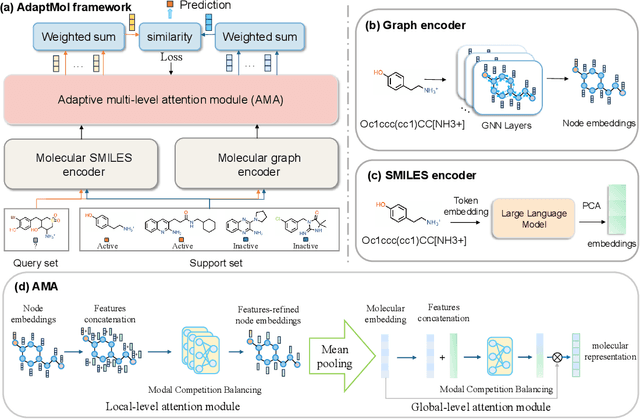
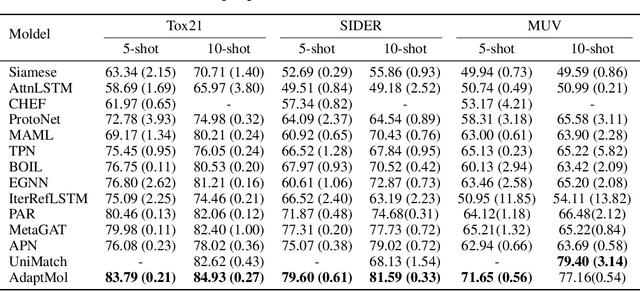
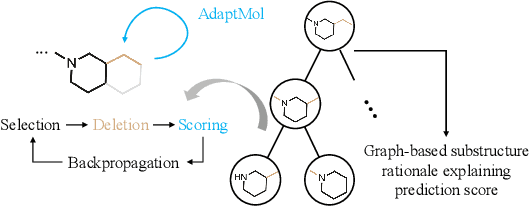
Accurate molecular property prediction (MPP) is a critical step in modern drug development. However, the scarcity of experimental validation data poses a significant challenge to AI-driven research paradigms. Under few-shot learning scenarios, the quality of molecular representations directly dictates the theoretical upper limit of model performance. We present AdaptMol, a prototypical network integrating Adaptive multimodal fusion for Molecular representation. This framework employs a dual-level attention mechanism to dynamically integrate global and local molecular features derived from two modalities: SMILES sequences and molecular graphs. (1) At the local level, structural features such as atomic interactions and substructures are extracted from molecular graphs, emphasizing fine-grained topological information; (2) At the global level, the SMILES sequence provides a holistic representation of the molecule. To validate the necessity of multimodal adaptive fusion, we propose an interpretable approach based on identifying molecular active substructures to demonstrate that multimodal adaptive fusion can efficiently represent molecules. Extensive experiments on three commonly used benchmarks under 5-shot and 10-shot settings demonstrate that AdaptMol achieves state-of-the-art performance in most cases. The rationale-extracted method guides the fusion of two modalities and highlights the importance of both modalities.
EDBench: Large-Scale Electron Density Data for Molecular Modeling
May 14, 2025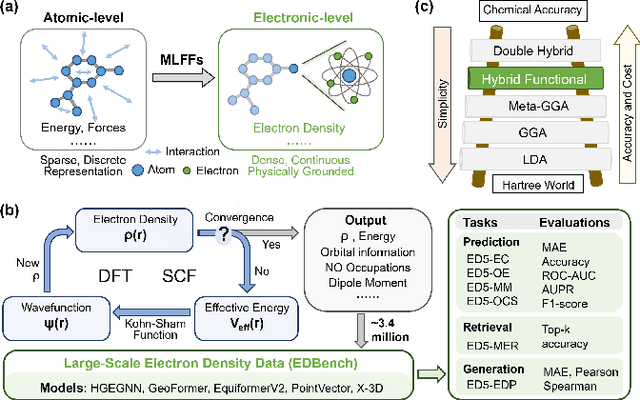
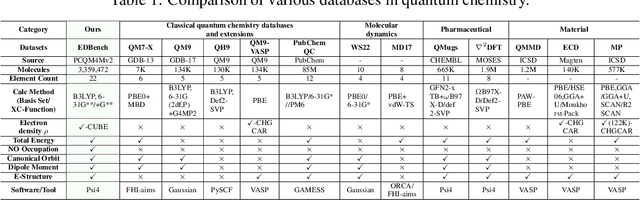

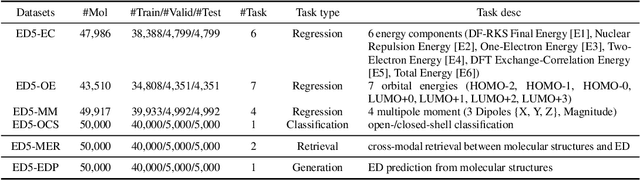
Existing molecular machine learning force fields (MLFFs) generally focus on the learning of atoms, molecules, and simple quantum chemical properties (such as energy and force), but ignore the importance of electron density (ED) $\rho(r)$ in accurately understanding molecular force fields (MFFs). ED describes the probability of finding electrons at specific locations around atoms or molecules, which uniquely determines all ground state properties (such as energy, molecular structure, etc.) of interactive multi-particle systems according to the Hohenberg-Kohn theorem. However, the calculation of ED relies on the time-consuming first-principles density functional theory (DFT) which leads to the lack of large-scale ED data and limits its application in MLFFs. In this paper, we introduce EDBench, a large-scale, high-quality dataset of ED designed to advance learning-based research at the electronic scale. Built upon the PCQM4Mv2, EDBench provides accurate ED data, covering 3.3 million molecules. To comprehensively evaluate the ability of models to understand and utilize electronic information, we design a suite of ED-centric benchmark tasks spanning prediction, retrieval, and generation. Our evaluation on several state-of-the-art methods demonstrates that learning from EDBench is not only feasible but also achieves high accuracy. Moreover, we show that learning-based method can efficiently calculate ED with comparable precision while significantly reducing the computational cost relative to traditional DFT calculations. All data and benchmarks from EDBench will be freely available, laying a robust foundation for ED-driven drug discovery and materials science.